gk-mvp
Distributed food system optimizing local supply matching.

Problem Defined
"Food waste is high because producers lack coordination to reach distributors."
Strategic Context
Localized systems suffer from supply-demand drift.
Competitive Imbalance
Producers lack a coordination layer for effective redistribution.
System Hypothesis
A structured coordination node increases resource resilience.
Process Architecture
How the system was designed, tested, and refined.
DEFINE
Identify coordination failures in localized food systems.
- • Audited local producer waste
- • Mapped supply-demand drift in community kitchens
- • Identified logistics silos
- • Focused on supply volume, ignored the timing of perishables
- • Food systems are timing-critical; coordination must be near-real-time
- • Reframed as a dynamic logistics coordination system
MAP
Map local supply nodes to distribution touchpoints.
- • Created supply matching diagrams
- • Mapped route optimization paths
- • Initial maps were too centralized; ignored node-to-node exchange
- • Resilience requires distributed, not just centralized, matching
- • Updated system map to support peer-to-peer node transfers
VALIDATE
Test matching efficiency and waste diversion.
- • Ran pilot with 40 community food nodes
- • Measured matching velocity
- • Producers were overwhelmed by high-frequency updates
- • Input friction must be minimal for busy small-scale producers
- • Integrated simple "one-tap" supply flagging
EXECUTE
Build the supply matching and logistics engine.
- • Supply matching engine
- • Logistics coordination layer
- • Node dashboard
- • Over-built the inventory management features early on
- • The matching node is more valuable than a database
- • Prioritized immediate matching alerts over long-term history
MEASURE
Calculate waste diversion and community node health.
- • Matching efficiency
- • Waste diversion tonnage
- • Node activity
- • Metrics focused on calories, not nutritional density or timing
- • Network health is defined by node response time, not just volume
- • Introduced response-time calibration for matches
Rule Application
How doctrine was operationalized.
Intellectual Rigor
01_INT- • Mapping food circularity loops
- • Defining systemic friction points
2 tons of waste diverted via structured coordination in first year
Tactical Execution
02_TAC- • Shipping basic matching first
- • Iterating on logistics routes
System operational with first 10 nodes in 14 days
Human Calibration
03_HUM- • Reducing administrative burden for volunteers
- • Designing for mobile-first coordination
Over 500 meals facilitated via zero-admin volunteer flows
Machine Leverage
04_AI- • AI-driven supply/demand signaling
- • Automated route planning
AI predicts supply surges before they become waste
Product Architecture
Supply matching engine, contributor onboarding, logistics flows.
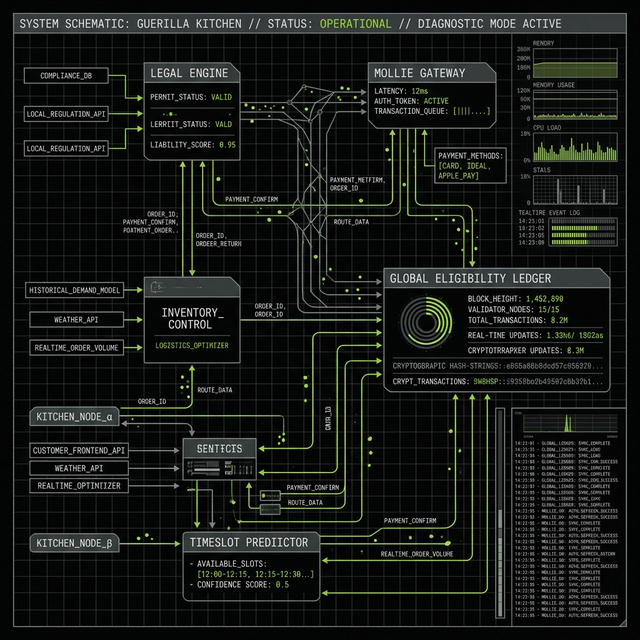
AI Leverage
Supply/demand signaling and automated route planning.
Outcomes & Learnings
Reduced waste through structured community coordination.
Launch System