01 // Thesis
Degraded
Coordinate.
The Problem
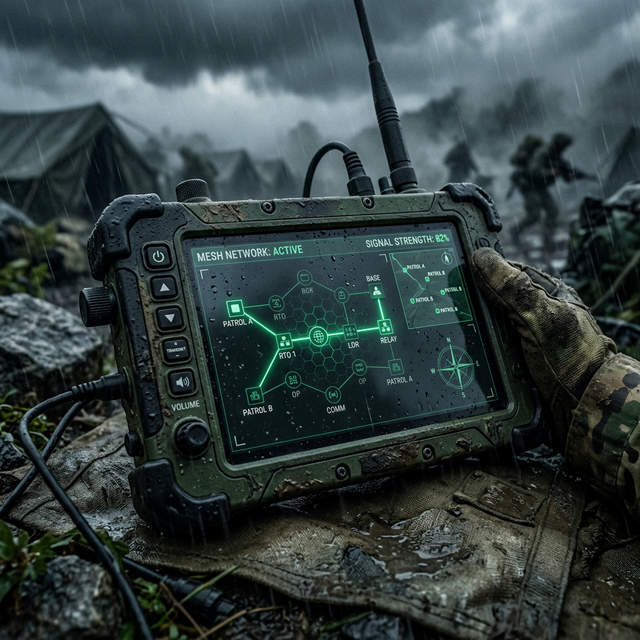
Centralized coordination systems are fundamentally fragile. In crisis zones, maritime corridors, or conflict environments, high interference and intermittent connectivity render hub-and-spoke models non-functional. When the central authority node is unreachable, the operational picture fragments, leading to coordination failure.
Hypothesis
"Mesh-based synchronization utilizing priority-state compression and optimized CRDTs enable resilient coordination tools that maintain a shared operational picture even in environments with 90% packet loss."
02 // Methodology
Protocol
Stress.
Packet Loss Simulation
Simulating 50% to 95% random packet loss and high-latency Jitter (2000ms+).
CRDT vs Delta-State
Benchmarking convergence time of state-based CRDTs against optimized delta-propagation.
State Compression
Heuristic-based pruning of non-critical state updates to minimize payload size.
Conflict Resolution
Validating causality tracking using Vector Clocks in decentralized node clusters.
03 // Findings
Observed
Metrics.
Mesh architectures consistently outperformed hub-and-spoke topologies under sustained degradation. State compression was most effective in scenarios where 80% of data - such as high-frequency telemetry - could be safely discarded in favor of critical positional and command updates.
"Conflict resolution complexity increases non-linearly with node count. For clusters exceeding 50 nodes, hierarchical sharding of the mesh is required to maintain sub-second state consistency."
04 // Applications
Operational
Targets.
Disaster Zones
Infrastructure-free coordination for first responders in blackout scenarios.
Maritime Coordination
Secure state-sharing between vessels in low-bandwidth satellite zones.
Rural Agri Networks
Resilient sensor-sync in remote agricultural clusters with intermittent cellular coverage.
Decentralized NGOs
Coordination of personnel and logistics in connectivity-compromised regions.
Protocol Validation Phase: Active
Review Protocol Whitepaper