
01 // Thesis
Structural
Breakdown.
The Core Bottleneck
Emergency dispatch systems are inherently fragile under multi-point crisis conditions. When incident density exceeds a critical threshold, standard resource allocation models - typically built on static, hierarchical rule trees - revert to reactive, first-come-first-served logic. In these scenarios, the system loses the ability to perform global optimization, leading to sub-optimal outcomes where non-critical demands deplete resources required for high-stakes interventions.
Hypothesis
"LLM-assisted priority weighting can dynamically rebalance dispatch logic using contextual reasoning, allowing for real-time recalibration of resource value in environments of radical uncertainty."
02 // Methodology
Experimental
Parameters.
Our research utilized a proprietary Discrete Event Simulation (DES) environment to model a virtual metropolitan area under a sustained Class-4 emergency event (wildfire encroachment combined with electrical grid failure).
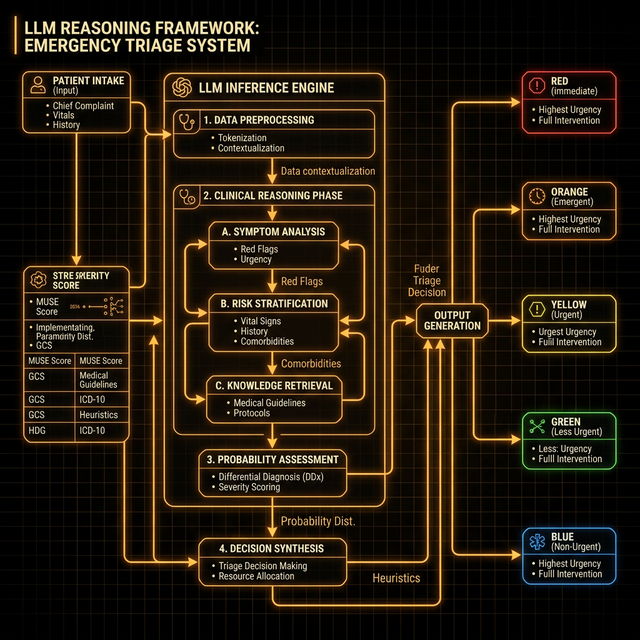
Multi-Node Scenarios
Incident generation across 1,200 nodes with overlapping dependency chains.
Variable Scarcity
Dynamic depletion of specialized units (Heavy Rescue, paramedics, aerial logistics).
Prompt Strategy
Comparison of zero-shot vs. recursive few-shot weighting for incident triage.
Override Modeling
Testing the friction of human interference in LLM-proposed priority shifts.
Benchmarking Protocols
- [1]Response latency under variable event-density.
- [2]Misclassification rates in ambiguous incident descriptions.
- [3]Resource utilization delta between LLM and static-rule baselines.
- [4]System recovery time following resource exhaustion events.
03 // Findings
Empirical
Observed.
Contextual Superiority
LLMs qualitatively outperformed static rules in scenarios with high ambiguity. For example, the system correctly de-prioritized a low-acuity hospital transport Request A in favor of a rising wildfire notification in proximity to a combustible storage facility, whereas static rules assigned equal weight based on time-stamps alone.
Critical Risk Observation
"Without constrained reasoning frameworks, the system demonstrated a tendency for 'contextual hallucination' - periodically assigning extreme weights to incidents based on inferred, but unverified, catastrophic outcomes. Successful deployment requires strictly bounded reasoning modules."
04 // Implications
Systemic
Migration.
This research represents an foundational shift from deterministic dispatch to intelligent, context-aware coordination systems.
Civil Emergency
Managed urban response during catastrophic environmental events.
Military Logistics
Priority routing for supply chains in high-interference kinetic zones.
Climate Response
Predictive resource scaling for multi-front wildfire and flood management.
Autonomous Traffic
Dynamic rerouting based on emergency signal priority and node saturation.
Phase // 02 Investigation Pending
We are currently seeking technical partners for Phase 02: Real-world stress testing on anonymized dispatch data.
Inquire About Research Data